How it works
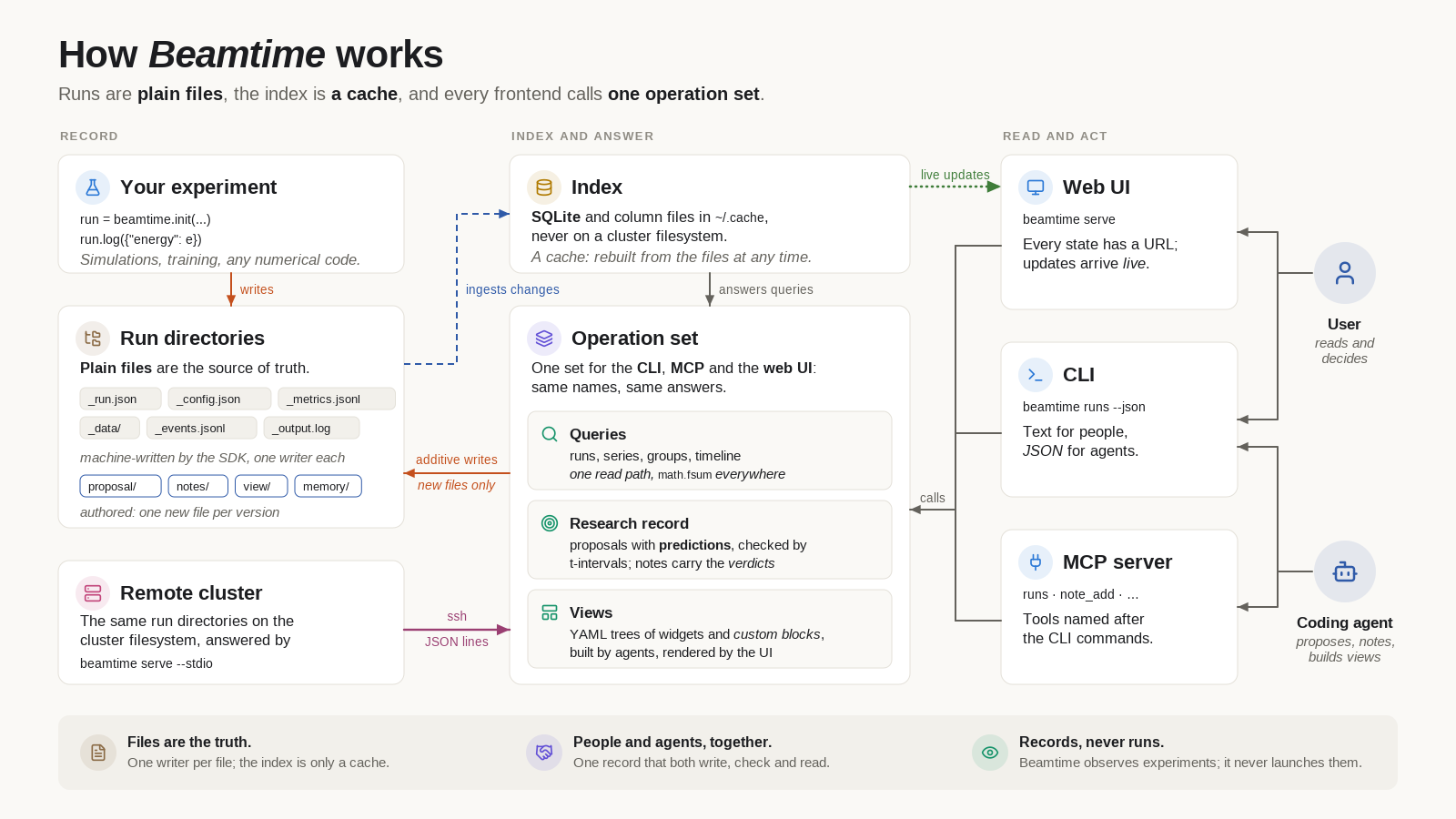
Runs are folders#
Each beamtime.init() creates a run: a folder of plain files (metrics, config, printed output).
Nothing is uploaded; copy, move or delete runs like any folder.
Groups are folders too#
dir="scaling/lr-sweep" puts the run in beamtime/scaling/lr-sweep/, a group. Groups hold runs
and other groups; use one per question.
A proposal says what you expect#
A group's proposal states the expectation, e.g. "lr 3e-4 converges fastest." Runs started afterwards record it, and Beamtime can check it against the numbers.
A verdict says what you found#
A verdict is confirmed, refuted or inconclusive, with a reason. Groups then show their status: open, being tested, concluded. See Proposals and verdicts.
Pages show it#
Each group and run has a page: the main curves, a run table and the notes. A view is a page an agent builds for one question; see Pages and views.
Notes and memory#
Notes record observations, questions and decisions. A group's memory is a short summary agents read first.
Agents use the same things#
Your agent reads runs, notes and pages through the same operations as the browser and the CLI. It
adds notes and pages but never deletes or moves anything; see Working with an
agent. The operations compute the numbers (importance ranks the config fields
that drive a metric); an agent's own Python calls them as functions through from beamtime import bt.